
Subjective Physicalism
The knowledge argument and subjectivity

I wrote the following note a while back:
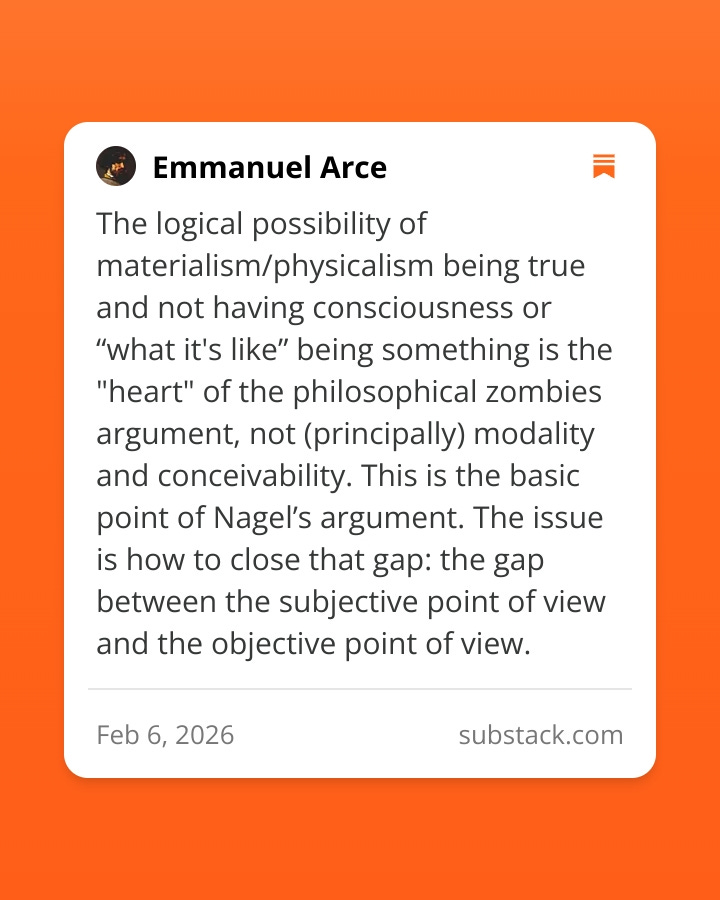
I now think that not only the philosophical zombies argument against physicalism—roughly, the view that holds that everything is physical—can be read or interpreted with the same Nagelian theme but also the knowledge argument (KA) against physicalism. In this article, I shall explain how.
First, let me explain the thrust of Thomas Nagel’s argument.
I. Consciousness as Subjectivity
According to Nagel in “What Is It Like to Be a Bat,” consciousness represents a problem for physicalism. He defines “consciousness” as the subjective character of experience. In this sense, an organism possesses consciousness if and only if there is something that it is like to be that organism. Consciousness implies possessing or having a particular or singular point of view. However, this sense or meaning of consciousness must not be confused with qualia or what Tim Crane (2019) calls the “phenomenal residue view” of consciousness. In a broad sense, qualia represent the subjective feelings or qualities of a sensory experience, like smelling a skunk, feeling a sharp pain, or seeing a bright purple patch.1 They’re kinda properties of sensory experiences. The phenomenal residue view conceives consciousness as something “inexpressible, ineffable, inefficacious, additional and separable from the rest of the mental life” (p. 82).
The Nagelian definition of consciousness simply says that consciousness involves a phenomenology, a specific way of seeing the world. That’s all. It’s consciousness itself, not just a “part” of it or something “contained” by or within consciousness, such as qualia. Also, it does not identify consciousness with the narrower conception implied by the phenomenal residue view. Now, what Nagel argues for is not the falsity of physicalism but that it has explanatory limits when we attempt to reduce consciousness to the physical. The difficulty precisely lies in the subjective character of consciousness:
If physicalism is to be defended, the phenomenological features must themselves be given a physical account. But when we examine their subjective character it seems that such a result is impossible. The reason is that every subjective phenomenon is essentially connected with a single point of view, and it seems inevitable that an objective, physical theory will abandon that point of view. (Nagel, 1979, p. 167)
The main issue with physicalism, according to Nagel, is that physical and reductive theories move toward greater objectivity, but this very “move” is antithetical to understanding subjective experience. Some phenomena are accessible to individuals with various perceptual systems and from a variety of perspectives due to the objective nature of scientific theories. These theories achieve this accessibility by moving away from a species-specific viewpoint toward a more general, objective description. Consciousness is only accessible from a single point of view; that move toward objectivity takes one farther away from the real nature of the phenomenon. In particular, while other natural phenomena aren’t exhausted by how they subjectively appear to humans (and so other species can understand those phenomena even though they don’t have our perceptual apparatus), the relationship of consciousness with subjectivity is very intimate. As Nagel (1979) says, “It is difficult to understand what could be meant by the objective character of an experience, apart from the particular point of view from which its subject apprehends” (p. 173).
As I said, this doesn’t mean that physicalism is false. What it implies for physicalism is that we are currently incapable of properly understanding it because the physicalist identity statements, such as, in general, “a mental thing x is physical,” require a conceptual understanding of what “mental” means or what consciousness is. We cannot determine whether physicalism is true without that understanding. So, consciousness is a problem for physicalism, not because it’s kind of a “spooky” non-natural or immaterial thing, but principally because it constitutes a (seemingly) irreducible phenomenology.
II. The KA and The “What Is It Like To Be” Argument
Frank Jackson takes roughly the same intuition behind Nagel’s argument, but he goes a step further: that physicalism is indeed false. Recall the Mary the super scientist thought experiment. Mary could know all the physical information when she was in the room where she was imprisoned. When she leaves the room, however, she learns something new about the world, color experience and vision after seeing red (or any other color, for that matter). Physicalism must be untrue if it is the belief that all information is at last physical2, since the thought experiment shows that physical information omits some aspects of the world. This result clearly is not the conclusion of Nagel’s argument.
In fact, Jackson acknowledges that the “What is it like to be” argument is different from the KA. For Nagel, what physicalism leaves out of account is the subjective character, while, for Jackson, it’s a specific sort of property of color and sensory experience, namely qualia. Jackson (1982) isn’t complaining that we aren’t finding out what it is like to be Mary. Rather, he is complaining that we are left ignorant of a fact about Mary’s experience and new knowledge. A property (or set of properties) that must be non-physical. Even if we knew this property, we still wouldn’t know what it is like to be Mary because we aren’t indeed Mary (p. 132)3.
More precisely, Nagel (1979) claims that “the more different from oneself the other experiencer is, the less success one can expect with this enterprise,” the enterprise of understanding a particular perspective (p. 172). So, conversely, creatures sufficiently similar to one another can take up each other’s point of view. This point is less important in the KA because it relies on the idea that any objective description, which can be understood from many perspectives, will always omit a certain quality of the experience, regardless of how similar the observers are. Thus, the KA essentially tells us that when we attempt to reduce qualia to the physical, objective physical descriptions fall short because qualia is taken to be non-physical. In this way, both arguments are different.
III. There’s Something (Wrong) about the KA
Now, in a previous post, I argued that Jackson’s argument faces a problem. In a nutshell, Jackson defines physicalism narrowly, implying that all genuine information is provided by the physical sciences; however, physicalism as a whole does not always entail such a commitment. For him, physicalism is the belief that a complete physical knowledge of the world implies a complete knowledge or understanding of the world. Physical sciences fix or determine all the facts. However, physicalism simpliciter is a metaphysical thesis that is not necessarily paired with an epistemological (or linguistic) thesis. In this sense, a bare physicalist may coherently hold that physicalism is true even though not all the information (or knowledge) provided by those sciences gives us a complete understanding of the world. As I stated in that article, there may be phenomenal or non-physical ways of knowing, but this does not undermine physicalism.
I mentioned Terence Horgan (1984) in that article and argued based on his distinction between “explicitly physical information” (information expressed in physicalistic and scientific language) and “ontologically physical information” (information about what exists—what entities, properties, etc., exist independently of the language in which that information is presented). He was among the first philosophers to assert that Jackson only calls into question the aforementioned narrow conception of physicalism; he also recognizes that physicalism can admit phenomenal knowledge. In particular, he concedes that Mary gains new factual knowledge upon experiencing color, but this does not imply that she has discovered a non-physical property or fact. This response lays out a comprehensive physicalist approach to dealing with the KA. That approach is usually termed “the phenomenal concepts strategy” in the literature. Actually, it’s part of a broader approach denominated by the SEP, the “New Knowledge/Old Fact View.” Essentially, the phenomenal concepts strategy admits that Mary gains new factual and propositional knowledge, but this knowledge involves only physical properties or facts. It’s a sort of “conceptual dualism,” since the new items of knowledge obtained through qualitative experiences are not, strictly speaking, physical.
So, we can say that we have two distinct, general conceptions of what physicalism is at work: on one hand, physicalism is the view that all genuine information is explicitly physical information, and on the other, it is the view that all genuine information is ontologically physical information. The first definition fits with Jackson’s conception, while the second is a broader definition of physicalism. This is essentially the view of Horgan and those philosophers who support the phenomenal concepts strategy. The first is accompanied by Jackson’s assumption that all facts are in principle derivable from complete physical knowledge or information; the second one doesn’t “demand” a specific epistemological thesis. In my article, I said that the KA needs that assumption to undermine physicalism as such. But making a case for this principle is the same as making a case for Jackson-style physicalism, and it’s not an obvious principle of physicalism as such; it is a strong epistemological thesis added to physicalism.
We can see the logical structure of the KA better if we write it down like this:
When she is imprisoned in her room, Mary knows all physical facts.
When she leaves her room, Mary learns a new fact a.
Mary did not know a based on her previous knowledge.
If a fact is a priori deducible from a complete knowledge of physical facts, then Mary could know that fact based on her previous knowledge.
a was not a priori deducible from a complete knowledge of physical facts.
If a fact is physical, then it must be deducible from a complete knowledge of physical facts.
a is not physical.
If there is at least one non-physical fact, then physicalism is false.
Therefore, physicalism is false.
We can see that the KA works if the central epistemological assumption (expressed by premise (6)) is true. If it isn’t, that new fact may not be a priori derivable or deducible and still be physical. But even if premise (6) (and the rest of the premises) were true, the KA would only show that a specific version of physicalism is false. Moreover, it seems to me that the KA also assumes something more subtle about Mary: if Mary knows all the physical facts, then she should be able to get qualitative experiences (or their full content) from that knowledge. She should be able to be in that kind of cognitive state because her complete physical knowledge is sufficient for complete knowledge of reality. But some philosophers have argued that Mary can only learn about color experiences if she has the states or experiences needed to do so. That is, you cannot have phenomenal knowledge without phenomenal experiences.
For instance, Torin Alter (1999) says that even if the KA is right in its conclusion that complete physical knowledge of consciousness omits facts about qualitative experiences, it’s not actually a defeater for physicalism. Physicalism can only be threatened by Mary’s discovery of new facts that she was unaware of before leaving the room if all physical facts are discursively learnable (i.e, by means of lectures and readings). Because some physical facts may be non-discursively learnable (i.e., they are learnable experientially), Mary’s discovery, by itself, doesn’t refute physicalism. The assumption that they should be discursively learnable is an epistemological one, and, again, physicalism is merely a metaphysical thesis. The first one is about how facts are known, while the second one is about what facts are.
An interesting take on the explanatory gap (but highly relevant to our discussion) is that of Substacker Zinbiel in Locating the Explanatory Gap. They argue that the explanatory gap isn’t primarily about an ontological irreducibility—the problem of reducing one kind of thing to another kind of thing. Instead, it’s about the inability and limitations of science to explain how qualia arise from their neural substrates or “roots.” In other words, it’s an epistemic problem, a problem concerning our knowledge. This gap can be approached from two distinct directions: the mental side and the neural (or neuroscientific) side. From the mental side, qualia seem to resist reductive explanation because they appear as irreducible, elemental experiences with no internal structure that we can break down into functional components. Qualia are or function as “representational primitives” in our cognitive system, and, for that reason, they seem opaque to us.
From the neuroscientific side, we try to derive or build qualia from our scientific descriptions of neural substrates (such as neural firing patterns and brain circuitry). Still, we end up without having qualia at all. That is, we are incapable of deriving or building qualia from our physicalist and neuroscientific theories because, as Zinbiel says, “neural firing patterns seem conceptually distinct from the way coffee tastes or the way pain feels, and there seems to be no way to start with the firing patterns and reach the feels.” Zinbiel calls the attempt to derive a live experience from a physical description Jacksonian Derivation. The Jacksonian Derivation is likely impossible. It doesn’t seem possible to jump from what a theory seeks to represent (i.e., the neural substrate) to an actual example of what is being represented (i.e., the qualitative property or quale). But this failure doesn’t suggest an ontological gap. Instead, it shows the reality of an epistemic or cognitive constraint of the human brain. Because an epistemic gap alone doesn’t entail an ontological gap, it’d be erroneous to infer dualism from this limitation.4
These remarks tell us something important about the KA. If Mary obtains phenomenal knowledge by entering phenomenal or qualitative states and it’s unlikely that those states can be derived and caused in a brain from explicitly physical information alone, then we don’t have a defeater for physicalism per se. We don’t, as physicalism, by itself, is not committed to the possibility of the Jacksonian Derivation or to Jackson-style physicalism. Also, it seems to me that these insights tell us something more significant than that fact about physicalism: some facts of the world—especially those involving subjectivity—cannot be fully understood through an objective description of the world. And now we’ve returned to the Nagelian theme.
IV. Objectivism
Regardless of what I’ve pretended to show so far, I don’t believe it represents the end of the KA. In fact, I mentioned at the beginning of the essay that the KA can be read in a “Nagelian manner.” In Jackson’s formulation of the KA, the argument is an argument against physicalism insofar as it presumes that, for physicalism to be true, qualitative experiences (or the qualitative properties of them) must be deducible/derivable from a physical description and that physical knowledge must cause qualitative, cognitive states. But what if we remove these elements of it? The primary concept that underpins the entire logical structure of Jackson’s formulation of the argument is “(explicitly) physical information.” Well, what if we replace it with the concept of objective information?
According to Robert Howell (2009), “Nagel had the right target all along” (p. 317). For him, Jackson would have better argued against the epistemic completeness of objective theories or descriptions of reality instead of physicalism. More precisely, the KA is repositioned here as a refutation of objectivism—the belief that a third-person, objective description of the world can be complete or that every aspect of reality is fully inteligible through a complete objective description alone. That is, subjective experience—first-person and perspective-dependent experience—is never required for knowledge and understanding. Objective description suffices for understanding and knowing all of reality.
Howell (2007) suggests two modifications for the argument:
Mary should be seen as possessing all objective information about the world (including physics, biology, and neuroscience), not just physical information.
The conclusion of the argument is not that physicalism as such is false, but that a complete objective description or theory of the world is not possible or that an objective description or theory cannot be complete.
In other words, the argument now says that all the objective information about the world is insufficient for a complete understanding of the world. What makes a theory an objective one is the necessary condition that “an objective theory cannot require that one enter or be able to enter any token state of determinate type T in order to fully understand states of type T” (Howell, 2009, p. 318). Under this condition, if a theory of experience requires a subject to actually have a specific experience to understand it, that theory is not objective. Objectivity seeks a “view from nowhere”—an understanding of the world that does not privilege or require any specific subjective perspective.
In this regard, the KA is neither an argument against physicalism nor an argument for dualism. Simply adding the dualist’s list of properties or psychic stuff to the list of facts of the world does not solve the problem. If dualism is presented as an objective theory—say, as an addendum to the laws of physics—it is just as vulnerable to the KA as physicalism. The issue, then, is not the ontological type of properties on the list, but the fact that the nature of some properties cannot be captured or expressed on a list at all and that our scientific representations have limits. Objective dualism and objective physicalism both struggle with this anti-objectivist version of the KA. In sum, Nagel has rightly identified the tension between objectivity and subjectivity but has not explicitly formulated it as a rejection of objectivism as such.
So, what I have tried to show in this essay all along is not (mainly) that the KA isn’t a solid argument and that physicalists can avoid the dualist conclusion. Instead, no purely objective description can yield full understanding of qualitative experience because understanding and knowing requires instantiating qualitative states. This is precisely the denial of objectivism. So, what have we got? Accepting the conclusion of this version of the KA could lead to Howell’s “subjective physicalism.” Essentially, subjective physicalism accepts the core ontological thesis of physicalism—that all genuine information is ultimately ontologically physical information—but denies objectivism. Subjective physicalism accepts, then, that there are some aspects of reality that are subjective, and those aspects “require” undergoing them to be fully grasped and known. Howell (2009) argues that subjective physicalism can be developed in two different ways:
“A full physical description of the world leaves nothing out. All properties can receive objective, physical descriptions. Nonetheless, there are some properties that cannot be grasped fully unless they are grasped subjectively, via conscious experiences, as well as by objective physical descriptions.”
“Some physical properties can be grasped only subjectively. The properties that underwrite conscious experiences (e.g. qualia) are physical, but they are not identical with any property mentioned in a completed physics.” (p. 316)
Howell (2007) contends that several of the physicalist responses to the original formulation of the KA implicitly presuppose the falsehood of objectivism and accept subjective physicalism. But I won’t discuss or defend those versions of subjective physicalism any further in this article. The main point of this article’s general argument is that physicalism can be subjective. If there is an epistemic or cognitive gap in the case of Mary, this gap is best understood as the gap between representation and instantiation. As Zinbiel argues (in their aforementioned article), we cannot move from a description of neurons to a phenomenal or qualitative experience through analysis alone—we cannot generate the feeling of redness by studying, describing, and representing neurons. This is what they call a “Lesser Gap.” But given that objective theories operate at the level of representation, they cannot provide a complete account of phenomena whose understanding requires instantiation. Therefore, objectivism is false, even if physicalism is true. Physicalism might be true even if a complete physical description cannot yield qualitative property instantiation in principle.
V. Conclusion
In sum, the KA might be better interpreted as an argument against objectivism rather than physicalism. In this sense, the KA and the “What is it like to be” argument amount to the same thing, namely, facts about subjectivity are (partially) excluded in a complete theoretical and physical knowledge of the world (assuming that such a thing is possible). This proposition is not logically incompatible with the main core tenet of physicalism. Even if we grant that Mary learns something new when she sees red or that there is “phenomenal knowledge,” that does not refute physicalism—what it actually refutes is objectivism. The anti-objectivist version of the argument is neutral on physicalism and dualism. The task now is whether subjective physicalism makes sense in the final analysis (or whether it makes sense at all talking about “phenomenal knowledge” in the first place).
References
Alter, T. (1999). A Limited Defense of the Knowledge Argument. Philosophical Studies, 90(1), pp. 35-56.
Crane, T. (2019). A short history of philosophical theories of consciousness in the 20th century. In A. Kind (ed.), Philosophy of Mind in the Twentieth and Twenty-First Centuries (pp. 78-103). Routledge.
Horgan, T. (1984). Jackson on Physical Information and Qualia. The Philosophical Quarterly, 34(135), pp. 147-152.
Howell, R. (2007). The Knowledge Argument and Objectivity. Philosophical Studies, 135(2), pp. 145-177.
Howell, R. (2009). The Ontology of Subjective Physicalism. Nous, 43(2), pp. 315-345.
Jackson, F. (1982). Epiphenomenal Qualia. The Philosophical Quarterly, 32(127), pp. 127-136.
Nagel, T. (1979). What is it like to be a bat?. In Mortal Questions (pp. 165-180). CUP.
That is how Jackson defines physicalism in “Epiphenomenal Qualia.” I questioned that definition in a previous post.
I'm extrapolating Jackson’s statement about Fred’s case—the man with extra color vision—to Mary’s. At least for me, there doesn’t seem to be much of a difference between those cases.
I must say that anything that I conclude and argue from Zinbiel’s arguments are my conclusions and arguments, not theirs. Zinbiel might not agree with all of this. So please do not attribute this article’s overall view to Zinbiel.
Very interesting! I wasn't aware of subjective physicalism, I'll have to read more. I do wonder if this is a bit of a cheat: "the properties that underwrite conscious experiences (e.g. qualia) are physical", as I see the existence of qualia as a defining characteristic of modern dualism. The physicalist can always expand their notion of what the word "physical" means, but at some point they are just relabeling dualism as physicalism.
I love this. I was thinking something similar recently, about how even if we imagine there are objective qualia particles/whatever in immaterial souls, we could still make Chalmer's zombie argument. Like, we could imagine angels in heaven making all the same arguments about each other and how they can conceive of zombie angels that are behaviourally identical.